

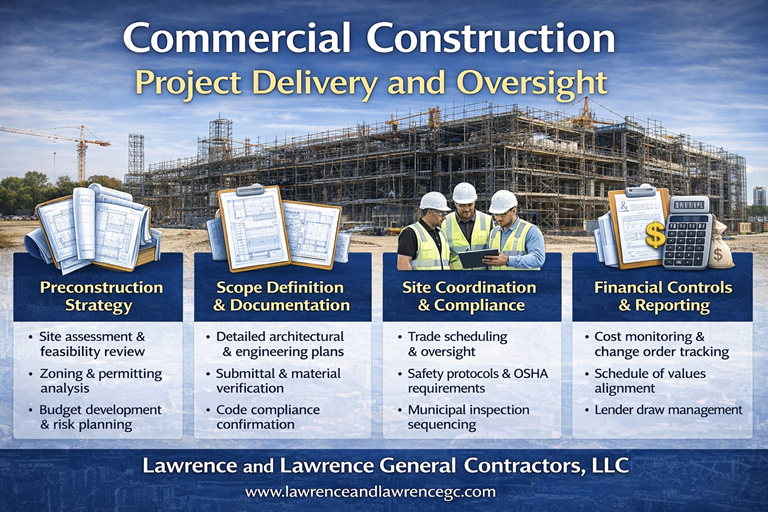
Commercial construction project delivery requires disciplined planning, regulatory awareness, and structured coordination. In Memphis, TN, commercial projects must align with zoning requirements, life safety codes, accessibility standards, and schedule-driven performance benchmarks. Lawrence and Lawrence General Contractors, LLC approaches commercial construction project delivery with documentation-based controls, inspection sequencing, and compliance oversight from preconstruction through final turnover.
Preconstruction Strategy and Feasibility Controls
Early phase planning determines cost stability and schedule reliability. A structured feasibility process reduces exposure to design revisions and permitting delays.
Preconstruction typically includes:
• Site evaluation and utility verification
• Zoning and land use review
• Budget development and cost modeling
• Preliminary schedule mapping
• Risk identification and mitigation planning
Coordination with architects, engineers, and municipal reviewers during this phase prevents downstream disruption.
Learn more about our Commercial Construction services:
https://www.lawrenceandlawrencegc.com/services/commercial-construction/
Scope Definition and Documentation Discipline
Clear scope definition protects owners from uncontrolled cost growth. Commercial construction project delivery requires coordinated construction documents across architectural, structural, mechanical, electrical, and plumbing disciplines.
Project controls focus on:
• Drawing version management
• Submittal and shop drawing review
• Specification verification
• Code compliance confirmation
• Inspection scheduling protocols
Tennessee municipalities operate under adopted International Building Code standards. Reference guidance is available through the International Code Council:
https://www.iccsafe.org/
Trade Coordination and Site Oversight
Active job site management requires structured sequencing of trades and safety monitoring aligned with OSHA regulations.
Construction phase priorities include:
• Weekly coordination meetings
• Safety compliance enforcement
• Schedule milestone tracking
• Budget variance reporting
• Quality assurance inspections
Commercial environments may require phased occupancy or operational continuity planning. Coordinated sequencing minimizes business interruption.
Regulatory Compliance and Inspection Sequencing
Commercial construction project delivery depends on timely inspection approvals and regulatory clearance.
Compliance areas include:
• Fire suppression and alarm systems
• Life safety egress pathways
• ADA accessibility standards
• Energy code compliance
• Structural inspection approvals
Inspection sequencing errors often create avoidable project delays.
Financial Controls and Cost Reporting
Budget management requires disciplined tracking against approved cost schedules.
Effective financial oversight includes:
• Schedule of values alignment
• Monthly cost reconciliation
• Change order documentation
• Contingency tracking
• Lender draw coordination when applicable
Transparent reporting supports informed owner decision making.
Performance and Lifecycle Considerations
Commercial buildings must perform beyond certificate of occupancy. Material durability and system efficiency influence operating costs and long-term asset value.
Performance considerations include:
• High-efficiency mechanical systems
• Durable exterior envelope assemblies
• Moisture intrusion mitigation
• Roofing system lifecycle planning
• Maintenance documentation turnover
Well-structured commercial construction project delivery protects capital investment while supporting operational continuity.
For projects requiring expanded capacity, review our Industrial Construction services:
https://www.lawrenceandlawrencegc.com/services/industrial-construction/